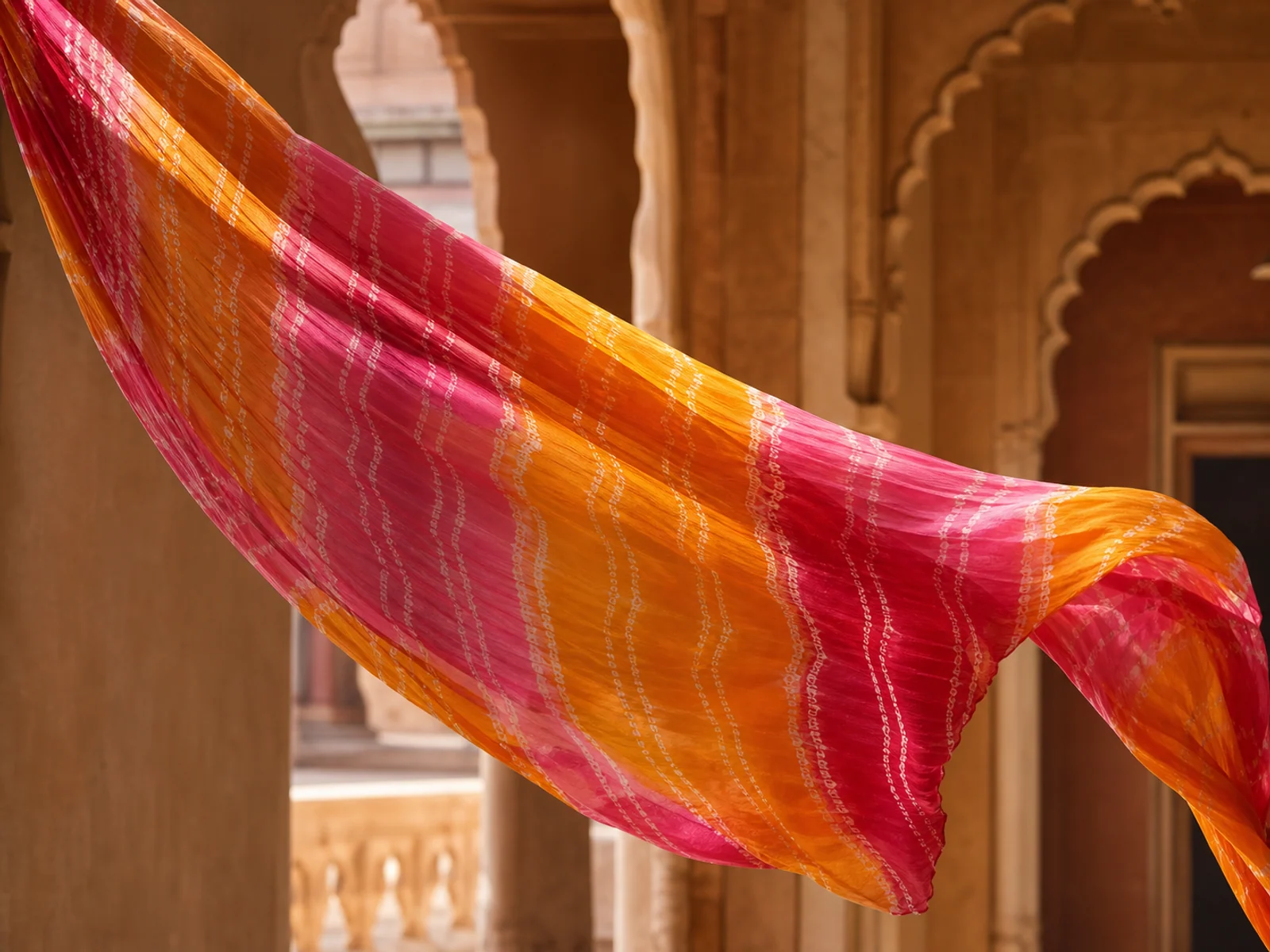
Leheriya takes its name from leher—the wave. Cloth is rolled or folded on the diagonal and bound at intervals before dyeing. When opened, the resisted lines travel across the surface like rain driven by wind. The technique is closely associated with Rajasthan’s festive and monsoon wardrobes.
“The hand is visible not in one perfect mark, but in the rhythm carried across the cloth.”
How the wave is formed
The artisan rolls fine cloth tightly from one corner, creating a long diagonal rope. Thread is tied at measured intervals; the exposed ridges take dye while compressed, bound areas resist it. After drying and opening, a field of parallel waves appears.
For multiple colours, binding and dyeing can be repeated. Mothara introduces another diagonal direction, turning waves into a grid of small rhythmic intersections.
A textile made for movement
Leheriya is most alive when it drapes. On a dupatta, each fold interrupts the stripe and creates optical movement. On a kurta, careful placement can lengthen the silhouette or frame a central embroidered motif.
Modern styling
Let one wave field dominate and quiet the rest. A Leheriya dupatta can animate a plain suit; a wave-dyed kurta works with straight trousers and minimal metalwork. Deep blue feels contemplative, gulabi festive, marigold sunlit and amethyst distinctly evening.
Frequently asked
What is the difference between Leheriya and Bandhani?
Leheriya is created by diagonally rolling and binding cloth to form waves; Bandhani uses many individually tied points to form dots and motifs.
What is Mothara?
Mothara is a related tie-dye pattern made with crossing diagonal lines, creating a small checked or lentil-like grid.