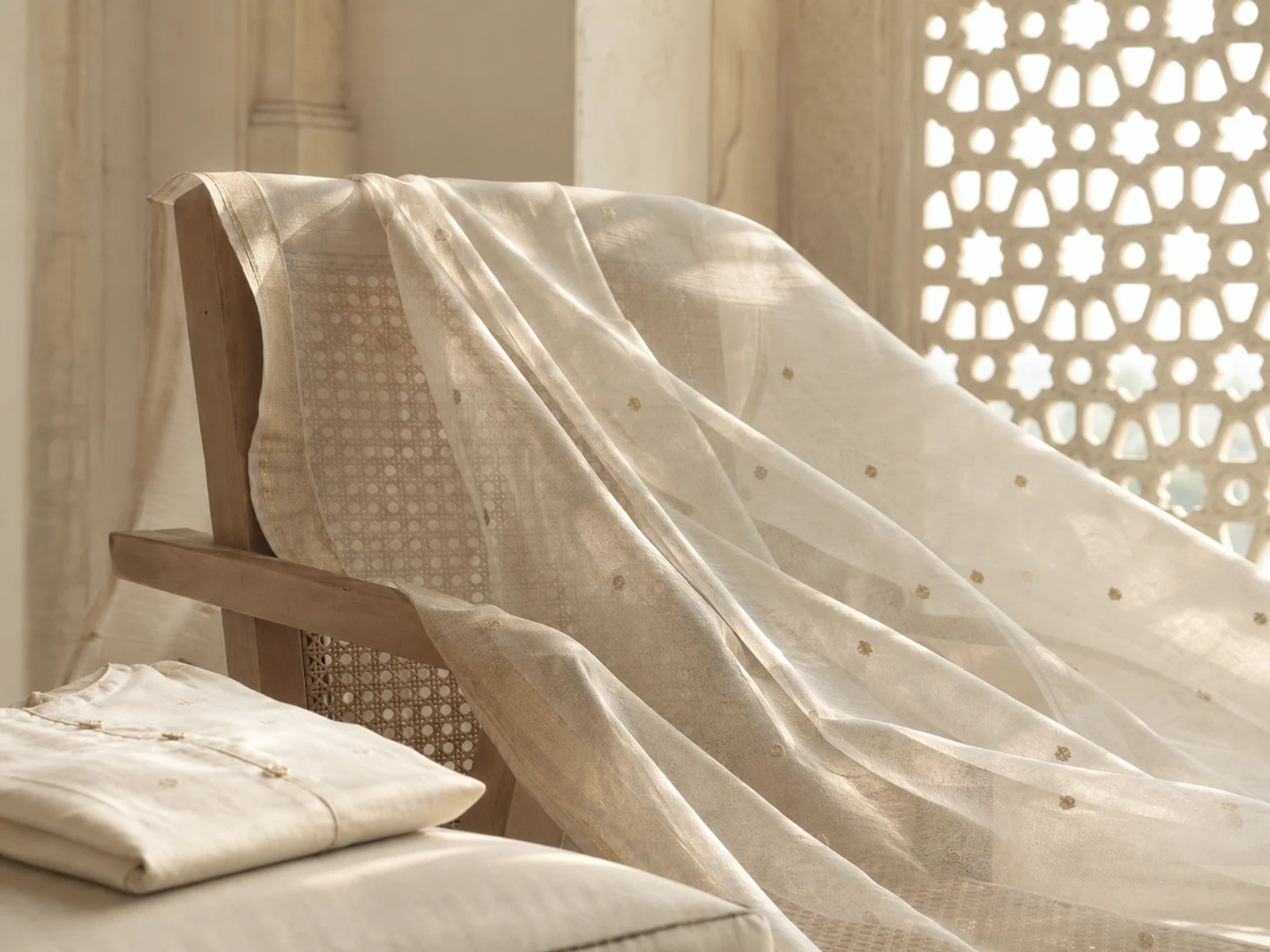
Chanderi is recognised by lightness, translucency and a fine, luminous surface. Woven in and around Chanderi in Madhya Pradesh, it enters a Jaipur atelier as a complementary canvas: delicate enough for Sanganeri-style butis, yet structured enough to carry a woven zari edge.
“The hand is visible not in one perfect mark, but in the rhythm carried across the cloth.”
Reading the cloth
Fine yarn and an open, balanced structure give Chanderi its characteristic air. Silk contributes lustre, cotton tempers the sheen and zari may define borders or small woven motifs. The resulting cloth feels formal without heaviness.
Why small butis work
A large, dense print can overwhelm translucent fabric. Small floral butis preserve light between motifs, allowing the ground to remain part of the design. A woven border then gives the composition a clear ending.
Care for a long life
Treat Chanderi as a delicate weave. Dry clean embellished pieces, avoid snagging jewellery and store flat or softly folded. Use tissue between folds and do not hang a heavy set for long periods, as the weave can distort.
Frequently asked
Is Chanderi always silk?
No. Chanderi textiles can be woven in silk, cotton or silk-cotton combinations.
Can Chanderi be worn in warm weather?
Its light structure is comfortable in warmth, though lined garments and the exact fibre blend affect breathability.