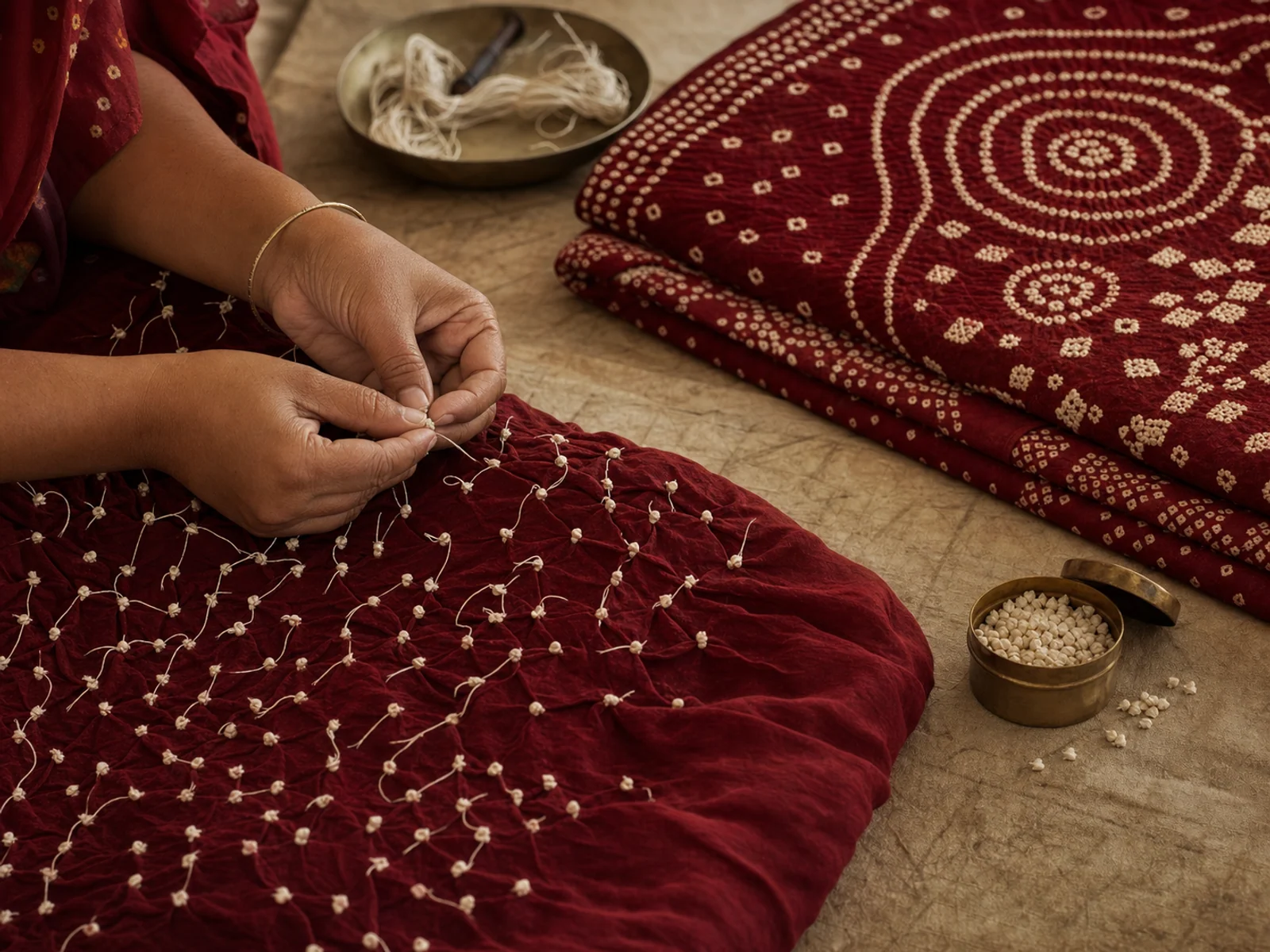
Bandhani—also called Bandhej—creates pattern through hundreds or thousands of minute ties. Artisans pinch tiny points of cloth, bind them tightly and dye the surface. When the threads are released, each tied point remains as a light dot. Gathered together, those dots become flowers, circles, grids and symbolic compositions.
“The hand is visible not in one perfect mark, but in the rhythm carried across the cloth.”
The discipline behind the dot
A design may first be marked with a perforated pattern or a removable guide. The tier lifts each point with a fingernail or small tool and winds thread firmly around it. Density, consistency and placement determine the clarity of the final motif.
Multi-colour Bandhani requires careful sequencing. Some ties are retained while others are added or removed between dye baths, protecting earlier colours while deeper tones develop.
Bandhani and Leheriya together
Rajasthan’s resist languages often meet within one ensemble. A Leheriya kurta can be balanced by a dotted Bandhani dupatta: long directional lines against a field of small points. The contrast is rhythmic without requiring heavy embellishment.
How to care for tied cloth
Do not pull or iron fresh Bandhani aggressively; the gathered texture is part of its character. Follow the maker’s care instructions, use cool water when washing is permitted and dry away from hard sun.
Frequently asked
Are Bandhani and Bandhej different?
They are commonly used as names for the same family of tied resist-dyeing traditions, with regional variations in vocabulary and pattern.
Why is new Bandhani fabric crinkled?
The pinched points remain gathered after the ties are opened. This texture is evidence of the tying process and relaxes with wear and washing.