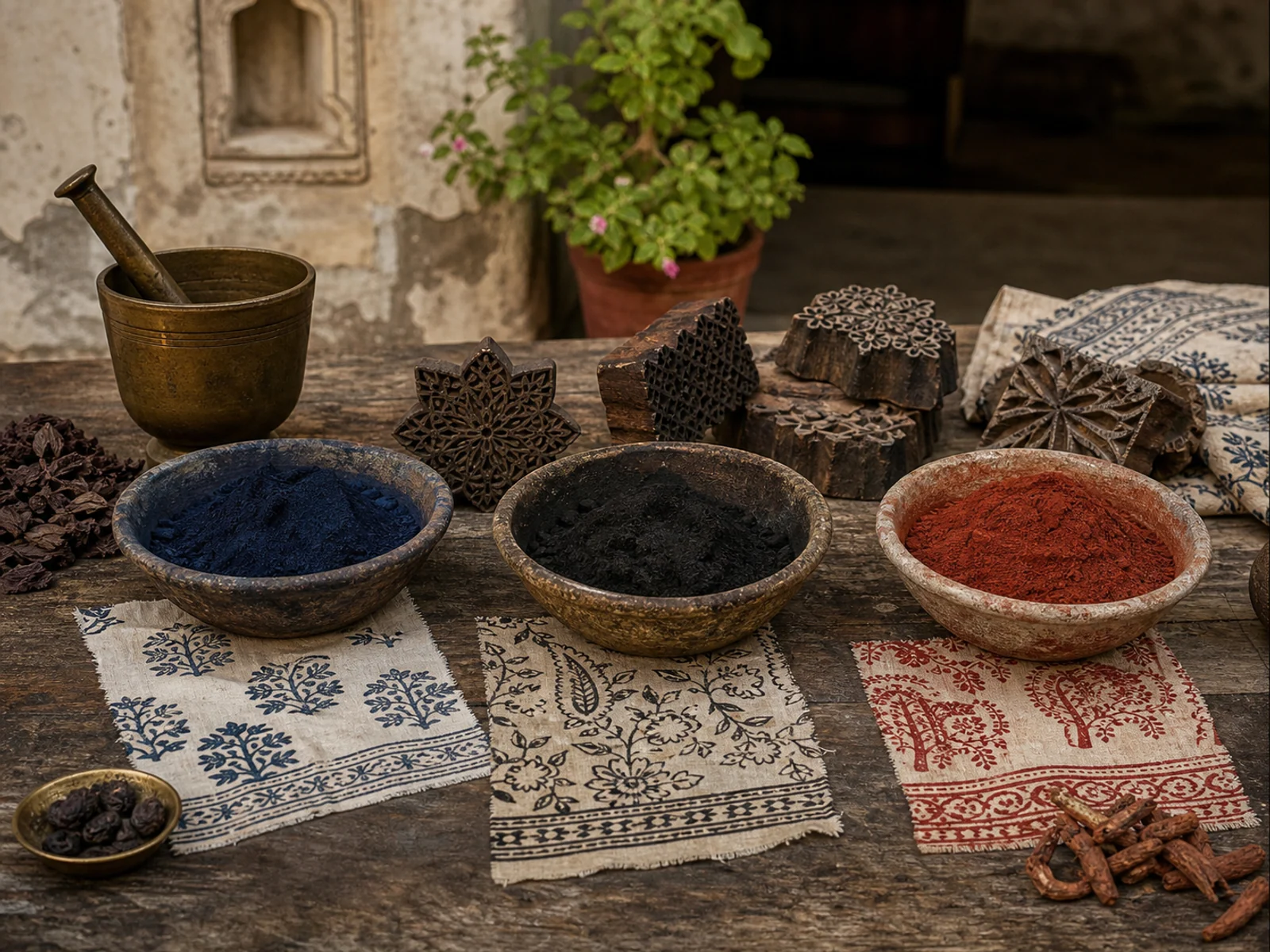
Bagru’s visual identity is carried as much by colour as pattern. Deep indigo, iron-rich black, warm red, ochre and unbleached cloth form a palette that feels excavated rather than applied. Traditional colour knowledge turns local materials and repeated washing into cloth with depth, variation and a strong sense of place.
“The hand is visible not in one perfect mark, but in the rhythm carried across the cloth.”
Colour as chemistry and memory
Traditional textile colour is a sequence of relationships: fibre preparation, tannin, mordant, dye, temperature, water and time. Iron can darken tannin-rich cloth; alum-based mordants help develop reds; indigo requires a reduced vat and oxidises into blue when exposed to air.
Not every modern Bagru textile uses an entirely natural palette. Ask for process details, since authentic regional identity and natural-dye certification are different claims.
Why earthy colour ages well
Mineral reds and indigo blues rarely depend on brightness alone. Their complexity allows gentle softening to feel graceful. Variations at block joints and across dye baths add tonal movement that becomes more personal with wear.
Building a wardrobe around Bagru
Treat iron black as a neutral, indigo as an evening colour and madder red as a warm accent. Natural linen, hand-spun cotton, old silver, tan leather and matte gold all sit comfortably beside this palette.
Frequently asked
Is every Bagru print naturally dyed?
No. Many workshops also use synthetic dyes. Look for transparent process information rather than assuming from the style alone.
What colours define traditional Bagru print?
Indigo blue, iron black, earthy red, ochre and the warm tone of the base cloth are strongly associated with the tradition.