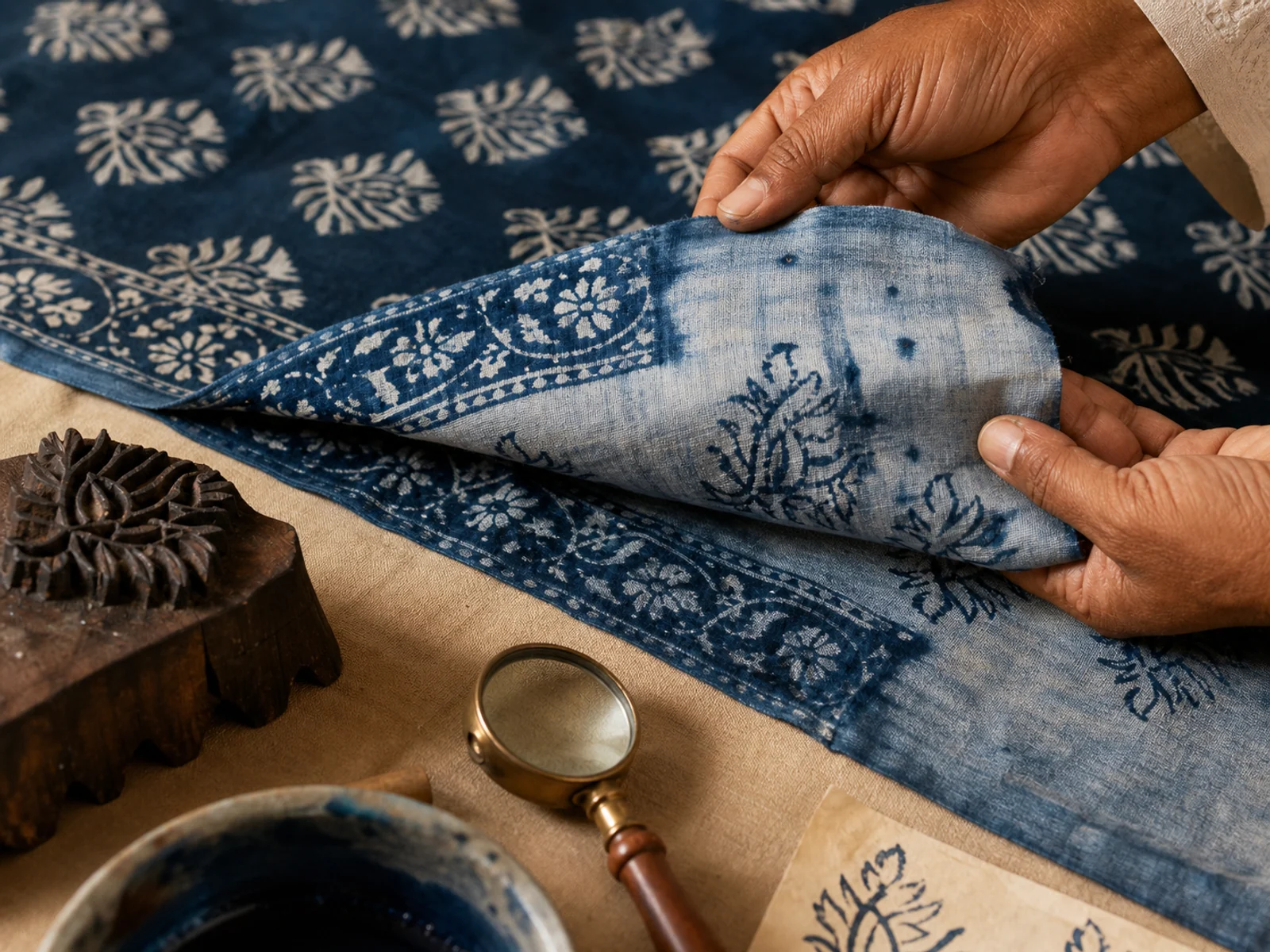
Authenticity is not proven by a single irregular dot. It emerges from a group of clues: how the motif repeats, how colour sits in the fibre, what the reverse reveals and whether the maker can describe the process. Use these observations to ask better questions, not to turn handmade cloth into a rigid checklist.
“The hand is visible not in one perfect mark, but in the rhythm carried across the cloth.”
Seven clues worth noticing
Study the repeat: tiny changes in pressure and alignment often appear where one block meets the next. Look at colour density across the motif and at fine outlines where a filling block may sit slightly inside or outside its boundary. Turn the cloth over; some dyes penetrate while metallic or pigment pastes may sit more on the face.
Feel for a surface appropriate to the process. Then ask practical questions: Was it printed in Bagru or Sanganer? Was the design direct printed or resisted? Which dyes were used? Who produced the fabric?
Irregularity is not automatically authenticity
Digital designs can simulate uneven edges, while genuinely handmade fabric can be extraordinarily precise. Conversely, smeared print, unstable colour or poor finishing should not be romanticised as craft. The goal is informed appreciation, not accepting any defect.
Buy the story you can verify
The strongest makers name the technique accurately, avoid unqualified sustainability claims and are comfortable describing fibre composition and care. That clarity supports both the wearer and the artisan ecosystem.
Frequently asked
Should hand block print always be uneven?
No. Skilled printers can achieve remarkable precision. Expect subtle human variation, not necessarily obvious misalignment.
Does a visible reverse prove hand printing?
Not by itself. Dye penetration varies by fibre and print chemistry. Use it alongside repeat, registration and provenance clues.